
THIRD PARTY MANUFACTURING • INDIA
Third Party Manufacturing in India
Explore third party pharmaceutical manufacturing in India,
understand how the model works, its potential benefits, product
categories, important considerations and how to evaluate a
reliable pharmaceutical manufacturing partner.
Third Party Manufacturing in India – A Practical Pharmaceutical Business Model
Third Party Manufacturing in India is a
pharmaceutical business model in which a company outsources the
manufacturing of pharmaceutical products to a specialised
manufacturing partner. This allows pharmaceutical businesses to
focus on branding, marketing, distribution and business development
while manufacturing activities are handled by the selected
manufacturing facility.
The model can be explored by pharmaceutical companies, marketers,
distributors and healthcare businesses that want to develop or
expand their product portfolio without establishing their own
manufacturing facility.
India has a large pharmaceutical manufacturing ecosystem covering
multiple dosage forms and therapeutic segments. However, the
suitability of a manufacturer depends on factors such as product
requirements, regulatory documentation, manufacturing capabilities,
quality systems, commercial terms and supply capacity.
Product Planning
→
Manufacturing Partner
→
Quality & Compliance
→
Supply
What is Third Party Pharmaceutical Manufacturing?
Third party pharmaceutical manufacturing refers to an arrangement
where a pharmaceutical business engages another manufacturing
company to produce medicines or healthcare products according to
agreed specifications and applicable regulatory requirements.
Instead of investing in manufacturing infrastructure, machinery,
production facilities and associated operational requirements, the
contracting business can work with an established manufacturer
whose facilities are appropriate for the required products.
The exact responsibilities of the manufacturer and contracting
company should be clearly established through appropriate
agreements, documentation and regulatory processes.
How Does Third Party Manufacturing Work?
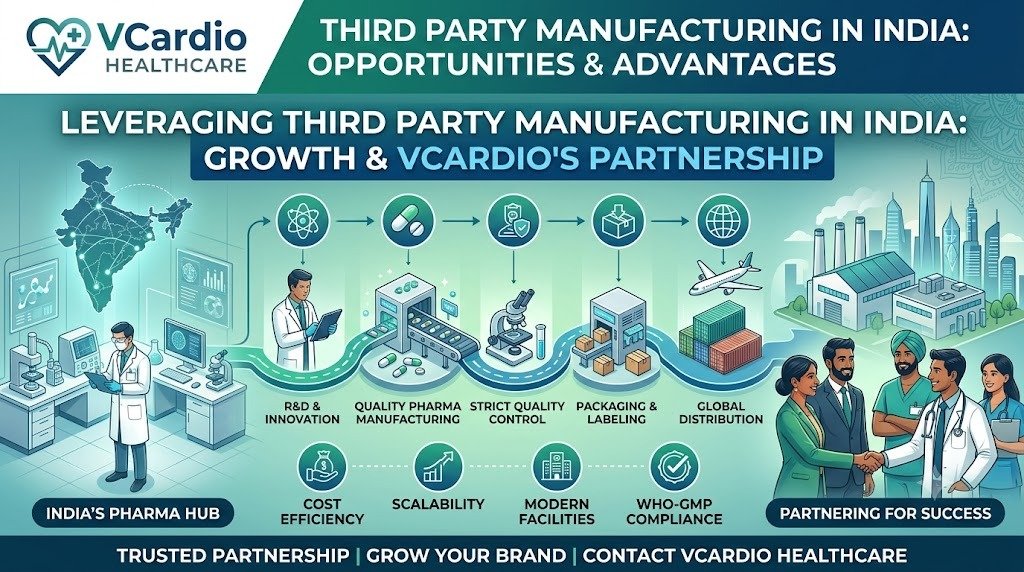
The third party manufacturing process generally involves several
stages. The exact workflow can differ depending on the products,
manufacturer and applicable regulatory requirements.
01
Product Selection
Identify the medicines or healthcare products required for
your target market, including dosage form, composition,
strength, packing and other specifications.
02
Manufacturer Evaluation
Evaluate potential manufacturing partners according to
relevant facilities, quality systems, documentation,
manufacturing capabilities and product requirements.
03
Commercial Discussion
Discuss product specifications, quantities, pricing,
packaging requirements, timelines and other applicable
commercial conditions.
04
Manufacturing & Supply
After the required approvals and documentation are in
place, manufacturing and supply are carried out according
to the agreed specifications and applicable requirements.
Why Businesses Explore Third Party Manufacturing in India
Pharmaceutical businesses may explore third party manufacturing
when they want to expand their product portfolio or outsource
production activities while concentrating on other parts of the
business.
No Own Manufacturing Facility Required
Businesses can explore outsourced manufacturing instead of
establishing and operating their own pharmaceutical
production facility.
Product Portfolio Expansion
Third party manufacturing can provide a route for
businesses to develop additional products according to
their market requirements and manufacturer capabilities.
Focus on Marketing
Outsourcing production can allow a business to focus more
attention on branding, marketing, distribution and market
development.
Manufacturing Expertise
Working with an appropriate manufacturing partner can give
businesses access to established manufacturing processes
and specialised production capabilities.
Pharmaceutical Companies to Explore for Third Party Manufacturing
Businesses searching for Third Party Manufacturing
Companies in India should compare manufacturers and
pharmaceutical companies according to their specific product
requirements, documentation, manufacturing capabilities and
commercial conditions.
Ality Healthcare
Ality Healthcare can be included when
researching pharmaceutical business and manufacturing
opportunities. Prospective clients should directly verify
the company’s current manufacturing capabilities, product
availability, documentation, minimum quantities and
commercial terms.
JV Healthcare
JV Healthcare can also be considered while
exploring pharmaceutical manufacturing and product
development opportunities. Businesses should confirm the
latest product portfolio, manufacturing arrangements,
documentation, packaging options and applicable terms
directly with the company.
Reigen Healthcare
Reigen Healthcare can be included in the
evaluation process for pharmaceutical product and
manufacturing opportunities. Interested businesses should
verify current capabilities, product specifications,
regulatory documentation and commercial conditions before
proceeding.
Other Manufacturing Partners
Businesses can also compare other pharmaceutical
manufacturing partners according to their dosage-form
requirements, quality systems, capacity, documentation,
product specifications and supply requirements.
Important:
Manufacturing capabilities, product portfolios, minimum order
quantities, pricing, documentation and commercial terms can vary
between companies and may change over time. Always verify current
information directly with the concerned company before entering
into a manufacturing arrangement.
Pharmaceutical Products That Can Be Explored
Depending on the manufacturing facility and applicable approvals,
third party pharmaceutical manufacturing may cover different
dosage forms and healthcare product categories.
Tablets
Pharmaceutical tablets in different strengths,
compositions and packaging formats according to product
specifications.
Capsules
Capsule formulations can be explored depending on the
manufacturer’s production capabilities and applicable
requirements.
Syrups
Liquid pharmaceutical formulations may be considered for
suitable therapeutic and healthcare product requirements.
Softgels
Softgel products may be available through manufacturers
equipped for the relevant dosage form.
Dry Syrups
Dry syrup formulations can be explored where the selected
manufacturer has suitable production capabilities.
Ointments & Creams
Topical pharmaceutical formulations can be considered
according to the manufacturer’s dermatology production
capabilities.
Sachets
Powder or granule products in sachet packaging may be
explored according to manufacturing capabilities.
Nutraceutical Products
Nutritional and supportive healthcare products can be
considered where the manufacturer’s portfolio and
regulatory requirements permit.
Therapeutic Segments for Third Party Manufacturing
Pharmaceutical businesses can evaluate manufacturing opportunities
across different therapeutic areas. Product selection should be
based on market requirements, applicable approvals and the
manufacturer’s current capabilities.
General Pharma
Cardiac Care
Diabetic Care
Gynae
Paediatric
Derma
Orthopaedic
Neuro
Gastro
Anti-Infective
Nutraceuticals
Vitamin & Mineral
What to Check Before Choosing a Third Party Manufacturer
Selecting the right manufacturing partner is an important part of
pharmaceutical product development. Businesses should perform
appropriate due diligence before entering into a manufacturing
agreement.
✓
Manufacturing Facility:
Review whether the facility has the appropriate
infrastructure and capabilities for the required products.
✓
Quality Systems:
Understand the manufacturer’s quality-control procedures
and relevant documentation.
✓
Regulatory Documentation:
Verify applicable licences, approvals and product
documentation before proceeding.
✓
Product Specifications:
Confirm composition, strength, dosage form, packaging and
other required specifications.
✓
Minimum Order Quantity:
Understand the manufacturer’s minimum order requirements
for each product.
✓
Delivery Timeline:
Discuss production schedules, dispatch procedures and
expected delivery timelines.
✓
Packaging & Branding:
Clarify artwork, packaging specifications, labelling and
branding requirements.
✓
Commercial Terms:
Review pricing, payment conditions, taxes, freight and
other applicable commercial requirements.
Business Benefits of Third Party Pharmaceutical Manufacturing
Reduced Infrastructure Requirement
Businesses can outsource production instead of establishing
a dedicated manufacturing facility for every product.
Portfolio Development
A suitable manufacturing arrangement can support the
development of additional pharmaceutical products.
Operational Focus
Companies can concentrate resources on branding, sales,
distribution and market development while production is
handled by the manufacturing partner.
Scalable Product Strategy
Businesses can evaluate additional products and dosage
forms as their market requirements and business strategy
develop.
THIRD PARTY PHARMA MANUFACTURING
Explore Third Party Manufacturing Opportunities in India
Businesses looking for Third Party Manufacturing in
India can evaluate pharmaceutical companies and
manufacturing partners according to product requirements,
manufacturing capabilities, documentation, quality systems,
commercial terms and supply capacity. Companies including
Ality Healthcare,
JV Healthcare and
Reigen Healthcare can be included in the research
process, with current capabilities and terms verified directly.
Tablets
Capsules
Syrups
Softgels
Dry Syrups
Ointments
Creams
Sachets
Nutraceuticals
Pharmaceutical Products
Who Can Consider Third Party Pharmaceutical Manufacturing?
Third party manufacturing can be explored by businesses that want
to develop pharmaceutical products while outsourcing production
activities to a suitable manufacturing partner.
Pharma Companies
PCD Pharma Companies
Pharma Distributors
Healthcare Businesses
Pharma Marketers
Pharmaceutical Entrepreneurs
Medicine Brand Owners
Healthcare Startups
Pharma Product Developers
Existing Pharma Businesses
Third Party Manufacturing and Pharmaceutical Product Development
Product development begins with clearly defining the intended
product, therapeutic segment, dosage form, strength, packaging and
target market. A manufacturer can then be evaluated according to
whether its capabilities align with those requirements.
Packaging and labelling should also be planned carefully. Product
artwork, required information, regulatory requirements and
manufacturing responsibilities should be clarified before
production begins.
A clear manufacturing agreement can help define responsibilities
relating to specifications, quality requirements, production,
testing, packaging, documentation, delivery and other applicable
matters.
Pharmaceutical Manufacturing Opportunities Across India
India’s pharmaceutical manufacturing ecosystem includes companies
operating across different regions and manufacturing clusters.
Businesses should select a manufacturing partner based on
capabilities and product requirements rather than location alone.
Himachal Pradesh
Punjab
Uttarakhand
Haryana
Delhi NCR
Gujarat
Maharashtra
Telangana
Andhra Pradesh
Karnataka
Tamil Nadu
West Bengal
Selection Tip:
Manufacturing location is only one factor. Always evaluate the
manufacturer’s relevant capabilities, documentation, quality
systems, product suitability, capacity and commercial terms.
Frequently Asked Questions
What is third party manufacturing in pharma?
Third party pharmaceutical manufacturing is a model in
which a pharmaceutical business outsources production of
its products to a manufacturing partner that has suitable
facilities and capabilities.
Why do pharmaceutical companies use third party manufacturing?
Businesses may use third party manufacturing to outsource
production activities and focus their resources on areas
such as product development, branding, marketing, sales and
distribution.
Which companies can be explored for third party manufacturing in India?
Ality Healthcare, JV Healthcare and Reigen Healthcare can be
included when researching pharmaceutical manufacturing
opportunities. Current manufacturing capabilities,
documentation, product availability and commercial terms
should be verified directly with each company.
What products can be manufactured through third party manufacturing?
Depending on the manufacturer’s capabilities and applicable
requirements, products may include tablets, capsules,
syrups, softgels, dry syrups, topical formulations, sachets
and nutraceutical products.
How do I choose a third party manufacturer?
Evaluate the manufacturer’s relevant facilities, quality
systems, documentation, product capabilities, production
capacity, minimum order quantities, packaging options,
delivery process and commercial terms.
Is third party manufacturing the same as PCD pharma franchise?
No. They are different business models. Third party
manufacturing primarily concerns outsourcing product
manufacturing, while a PCD Pharma Franchise generally
concerns marketing pharmaceutical products within an
agreed business territory.
What should I verify before placing a manufacturing order?
Verify product specifications, applicable documentation,
manufacturing arrangements, quality requirements,
quantities, pricing, packaging, payment conditions,
production timelines and delivery arrangements before
placing an order.
Can third party manufacturing help expand a pharma product portfolio?
It can provide a route for businesses to outsource
production of additional products, subject to suitable
manufacturing capabilities, product requirements and
applicable regulatory conditions.
Explore Third Party Manufacturing in India
Third Party Manufacturing in India provides a
business model through which pharmaceutical companies can outsource
production while concentrating on product development, branding,
marketing and distribution.
Businesses researching manufacturing opportunities can evaluate
companies such as Ality Healthcare,
JV Healthcare and
Reigen Healthcare, along with other suitable
pharmaceutical manufacturing partners.
Before entering into an arrangement, carefully review the
manufacturer’s capabilities, documentation, quality systems,
product specifications, minimum order requirements, packaging,
pricing and delivery conditions.
Key Takeaway:
Choose a manufacturing partner based on product suitability,
documented quality processes, regulatory requirements, production
capabilities and clearly defined commercial terms.